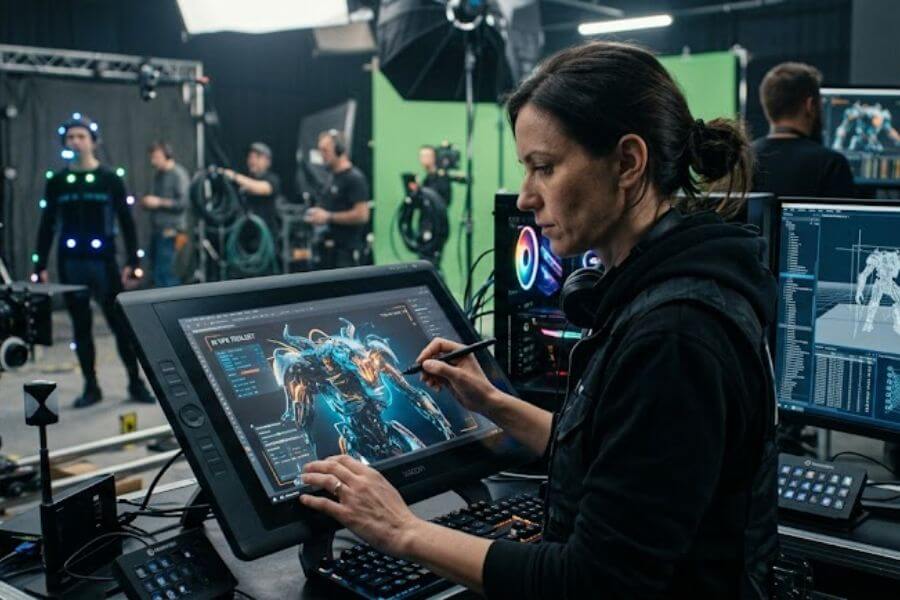
Key Takeaways
The integration of artificial intelligence into the world of cinematic visual effects is completely reshaping how modern blockbusters are conceived, filmed, and finalized. By automating labor-intensive processes like frame-by-frame rotoscoping, camera tracking, and crowd simulation, machine-learning models allow digital artists to move past mechanical tasks and focus heavily on pure creative experimentation. Technologies like Neural Radiance Fields and advanced generative networks are turning standard physical sets into highly dynamic, infinite digital environments while reducing the massive compute times and financial budgets historically required by traditional rendering pipelines. Ultimately, these advanced toolsets are bridging the gap between independent storytellers and major Hollywood studios, introducing a new era of highly flexible, hybrid filmmaking where human imagination remains the central driving force.
Introduction
Imagine stepping onto a massive Hollywood soundstage. The bright lights hover above a massive green screen, and hundreds of crew members hustle to adjust cameras, position props, and check tracking markers. For decades, this scene has defined the creation of modern blockbuster films. You watch as actors perform intense action sequences, knowing that months or even years of painstaking post-production work will follow just to turn those empty green backgrounds into a breathing, living alien planet or a historical city. The traditional path to cinematic spectacle has always been a battle of endurance, requiring thousands of visual effects artists to work around the clock, drawing digital masks, tracking individual points, and waiting for massive computer systems to process every single photon of light.
Today, a massive shift is taking place beneath the surface of the film industry. Artificial intelligence is no longer just a futuristic concept discussed in science-fiction screenplays; it has become the core engine driving the evolution of modern visual effects. When you look at the latest big-screen releases, you are witnessing a profound technological revolution. Machine-learning algorithms are quietly entering every single stage of the filmmaking pipeline, rewriting the rulebooks of computer-generated imagery and virtual production.
This transformation is completely changing how stories are told. It alters how directors think about their budgets, how actors approach their performances, and how visual artists execute their grandest visions. By analyzing millions of images and recognizing complex patterns in geometry, light, and movement, smart software can now handle tasks in a few minutes that used to consume entire weeks of manual labor.
As you dive into the technology behind today’s cinematic spectacles, you will see that this change is not about replacing the human touch that makes movies so emotionally resonant. Instead, it is about giving creators an incredibly powerful new paintbrush. This comprehensive guide explores the fascinating mechanics of these systems, the specific applications modern filmmakers use on set, and how this quiet digital revolution is permanently altering the landscape of blockbuster entertainment.
The Evolution of Movie Visual Effects
From Practical Effects to Digital Pixels
To truly appreciate the magnitude of the current technological shift, you must first look back at how the film industry arrived at this point. In the early days of cinema, visual spectacle relied entirely on physical ingenuity. Filmmakers depended on practical tricks, including detailed miniature models, hand-painted glass matte paintings, forced-perspective camera setups, and complex prosthetic makeup. If a director wanted to show a massive spaceship hovering over a city, an artist had to spend months building a physical model out of wood, plastic, and metal, capturing it frame by frame with a motion-control camera system.
The late twentieth century introduced the digital era, transforming the entire landscape. Computers allowed artists to create three-dimensional models inside virtual workspaces, giving birth to the term computer-generated imagery. Physical models slowly gave way to digital wireframes, and hand-painted glass was replaced by digital layers. This change offered unprecedented creative freedom, letting directors move the camera in ways that were physically impossible on a real set.
The High Cost of Perfection
While the digital transition unlocked limitless creative potential, it introduced an entirely new set of heavy demands. Creating photorealistic imagery requires immense computational power and an extraordinary amount of human labor. To make a digital character look truly alive, artists must manually sculpt every skin pore, paint thousands of individual texture maps, and simulate the complex behavior of muscles shifting beneath the skin.
Furthermore, the rendering process itself became a major bottleneck for film studios. To calculate how light bounces off different surfaces, filters through atmosphere, and enters a camera lens, massive server networks called render farms had to run continuously for days on end. A single frame of a complex action sequence could take dozens of hours to process. If a director decided to change the lighting or alter a character’s movement at the last minute, the entire process had to start over, sending production costs skyrocketing and pushing visual effects studios to their absolute limits.
The Arrival of Machine Learning
This brings you to the current era, where machine learning is stepping in to address these traditional bottlenecks. Instead of relying purely on rigid, step-by-step programming and manual asset creation, modern visual effects pipelines lean heavily on trained neural networks. These systems look at the vast archives of digital data created over the past thirty years of filmmaking, learning exactly how light interacts with matter, how human faces move, and how natural elements like water and fire behave.
By utilizing these learned patterns, smart software can predict and generate highly complex visual elements with astonishing speed. This does not mean the computer is making creative choices for the director; rather, it means the technical foundation required to realize those choices is handled with incredible efficiency. The arrival of machine learning marks a transition from a purely procedural, labor-intensive asset creation system to an intuitive, data-driven synthesis system, paving the way for the modern blockbuster landscape you see today.
De-Aging and Digital Character Cloning
Reversing the Clock on Screen
One of the most visible ways you experience artificial intelligence in modern cinema is through the flawless de-aging of well-known actors. For a long time, if a script required a character to appear forty years younger in a flashback scene, directors had very few choices. They could cast a younger actor who looked vaguely similar, apply layers of restrictive prosthetic makeup, or employ a team of digital artists to painstakingly smooth out wrinkles and reshape facial structures frame by frame.
Traditional digital de-aging was an incredibly expensive gamble. Artists had to treat the actor’s face like a digital painting, manually altering the skin texture while trying desperately to avoid the uncanny valley, that strange discomfort audiences feel when a digital human looks almost real but not quite right. If the tracking slipped by even a single pixel, the illusion fell apart instantly.
Neural Networks and Facial Datasets
The modern approach completely bypasses this manual frame-by-frame painting by using advanced neural facial reconstruction networks. When a studio decides to de-age an actor today, they begin by feeding an artificial intelligence model a massive dataset of the actor’s past performances. The system analyzes thousands of hours of archival footage, studying how that specific individual’s face looked, moved, and reacted to light when they were in their twenties or thirties.
During filming, the actor performs on set with specialized camera rigs, often wearing small dots on their face to track core movements. The trained neural network then takes this live performance and maps the youth characteristics from the archival data directly onto the actor’s current face. The software understands the underlying structure of the face, ensuring that when the actor smiles, frowns, or expresses subtle grief, the younger digital skin deforms in a perfectly natural, anatomically correct manner.
Preserving the Actor’s True Performance
The real triumph of this technology lies in how it protects the core artistic performance. In older visual effects workflows, the heavy layers of digital manipulation often muted or distorted the actor’s subtle expressions. Because the neural network acts as an intelligent overlay that understands depth, lighting, and anatomy, it preserves every single ounce of the actor’s original onset delivery.
You are not looking at a completely computer-generated puppet; you are looking at the actual performance of a seasoned performer, enhanced with historical facial data. This allows filmmakers to tell deeply emotional, multi-generational stories without breaking the audience’s immersion or forcing actors to sit in makeup chairs for hours before the cameras roll.
Comparison of Traditional De-Aging vs AI De-Aging
Younger versions of characters are common in cinema, but the methods used to achieve them have changed completely. The following comparison highlights how modern machine-learning workflows differ from previous digital methods.
Traditional Digital De-Aging:
- Relies heavily on manual frame-by-frame skin smoothing and 3D sculpting.
- Requires weeks or months of intensive labor for just a few minutes of screen time.
- Carries a high risk of looking unnatural due to human error in tracking.
- Severely limits on-set camera movement to keep the digital tracking points stable.
- Incurs massive financial costs that only top-tier studio productions can support.
Modern AI-Driven De-Aging:
- Utilizes neural networks trained on extensive archival footage of the actor’s youth.
- Synthesizes and applies the younger facial features across entire sequences in days.
- Maintains high photorealism by preserving micro-expressions and natural skin movement.
- Allows directors total freedom with camera angles and natural on-set lighting environments.
- Decreases post-production turnaround times, making it accessible for mid-budget films.
Deepfakes and Face-Swapping Technology
Seamless Stunt Doubles
Action blockbusters frequently push the boundaries of physical possibility. When you watch a superhero leap across a crumbling bridge or a secret agent engage in high-speed motorcycle chases, you know that a highly trained stunt double is often performing those dangerous maneuvers. Historically, keeping the stunt double’s face hidden required careful camera placement, fast editing cuts, or expensive digital face replacements using complex 3D models.
With modern face-swapping systems, directors can position the camera wherever they please during an action sequence. The stunt double performs the dangerous choreography under optimal conditions, and the smart software seamlessly swaps the double’s face with the lead actor’s visage during post-production. The system automatically matches the angle, lighting, shadow details, and motion blur of the original shot, making the transition completely invisible to the audience. This significantly improves safety on set while giving directors the freedom to shoot extended, unbroken wide shots of complex action.
Fixing Dialogue in Post-Production
Another incredibly practical application of face-swapping technology involves fixing dialogue mistakes after filming has wrapped. It is incredibly common for a director to realize during editing that a specific line of dialogue needs to change to clarify the plot. Traditionally, this required bringing the actor back into a recording studio for automated dialogue replacement, where they would speak the new line to match their original lip movements. If the new words did not fit the original mouth shapes, the scene would look disjointed.
Now, filmmakers can use generative facial models to alter the actor’s mouth movements on screen to perfectly match the newly recorded audio. The artificial intelligence analyzes the phonetic structure of the new words and gently redraws the lips, jawline, and cheeks of the digital character on screen. This saves productions from having to schedule costly reshoots or compromise on the clarity of their storytelling, keeping the narrative flowing smoothly.
The Ethical Boundaries of Digital Actors
As you observe these powerful tools becoming standard practice, it is impossible to ignore the profound ethical questions they introduce to the film industry. The ability to perfectly clone an individual’s likeness means that a performer’s image can exist independently of their physical presence. This has led to intense discussions regarding digital estate planning, likeness ownership, and worker protections.
Major industry unions and studio executives have established strict contractual rules to ensure that an actor’s digital double cannot be created or utilized without explicit consent and fair financial compensation. Filmmakers must navigate these new legal boundaries carefully, balancing the incredible creative flexibility these tools provide with a deep respect for the human artists whose faces and identities form the foundation of modern entertainment.
Automated Rotoscoping and Matte Generation
The Pain of Pixel-by-Pixel Cutting
Behind every breathtaking visual effects shot lies an invisible, often tedious process known as rotoscoping. If you want to place an explosion behind a character who was filmed on a regular location, or if you need to separate an actor from a complex background without a green screen, an artist must manually trace around the edge of that character frame by frame.
This process requires an extraordinary amount of patience and precision. A single second of film contains twenty-four individual frames, and a character’s hair, clothing, and limbs are constantly shifting. For decades, legions of artists spent long hours clicking their mice, moving thousands of tiny control points around moving silhouettes. It was widely considered one of the most grueling, time-consuming entry-level jobs in the entire post-production industry.
Smart Selection and Edge Tracking
Artificial intelligence has stepped into this space to lift the heavy operational burden off human shoulders. Modern rotoscoping tools utilize highly advanced computer-vision algorithms that understand the difference between foreground subjects and background elements. Instead of requiring an artist to trace every single frame, the operator can simply select the subject in a single frame using a few smart brush strokes.
The neural network then takes over, analyzing the pixel data across the rest of the sequence. It tracks the edges of the character with incredible accuracy, automatically accounting for complex details like individual strands of flying hair, sheer fabrics, and heavy motion blur. The system understands object permanence, meaning that if an object briefly passes behind a tree or another character, the software recognizes when it reappears and continues tracking it flawlessly.
Giving Time Back to Artists
By automating the vast majority of this mechanical tracing work, smart selection software has completely transformed the day-to-day lives of visual effects crews. Tasks that used to take a dedicated team an entire week can now be completed in a few hours.
This shift does not eliminate the need for human artists; rather, it elevates their role. Instead of spending days doing repetitive manual tracing, artists can spend their time refining the complex edge cases, perfecting the final color grade, and focusing on the artistic integration of the visual elements. It removes the mechanical friction from the creative pipeline, allowing post-production teams to iterate rapidly and deliver much more polished final imagery.
Environment Building and Background Synthesis
Virtual Production Meets Neural Radiance Fields
The way modern films construct their fictional worlds is undergoing an incredible evolution. For several years, the gold standard for high-end filmmaking has been virtual production, a technique where actors perform in front of massive, curved LED screens displaying real-time digital backgrounds. This allows the physical camera and the digital background to move in perfect harmony, creating realistic reflections on the actors’ costumes and props.
Now, artificial intelligence is supercharging this workflow through a technology called Neural Radiance Fields. This innovative system allows production crews to take a small handful of regular two-dimensional photographs of a physical location and convert them into a fully realized, photorealistic three-dimensional digital space. The neural network fills in all the missing gaps, calculating how light behaves from every single angle within that environment.
Generating Infinite Worlds Instantly
When you integrate these smart spatial models into the virtual production pipeline, the creative possibilities expand dramatically. If a director stands inside a digital reconstruction of an ancient temple and decides they want to move a stone wall fifty feet to the left, or change the entire layout of the pillars, they no longer have to wait for a 3D artist to rebuild the digital model from scratch.
Generative environment systems can synthesize new background elements on the fly based on natural language instructions or simple sketches. The system automatically applies the correct architectural style, surface textures, and weathering effects to match the existing environment. This gives filmmakers an unprecedented level of creative freedom, transforming the digital backdrop from a static, pre-rendered asset into a living, highly adaptive ecosystem that responds instantly to the director’s vision.
Enhancing the Volume and LED Walls
Using artificial intelligence to manage the content displayed on these massive LED walls also solves several persistent technical challenges inherent to virtual production. For instance, if the physical camera moves too close to the screen, an unwanted interference pattern known as a moiré effect can appear, breaking the illusion of depth.
Smart image processing systems monitor the camera’s position in real time and automatically adjust the sharpness, pixel structure, and contrast of the background imagery to prevent these visual artifacts from forming. The software can also dynamically upscale low-resolution background assets to crisp 8K fidelity on the fly, ensuring that the background remains perfectly sharp and convincing no matter how fast the camera moves or where the director chooses to look.
Crowd Simulation and Artificial Intelligence Behaviors
Beyond Simple Loop Animations
From historic battle scenes involving tens of thousands of soldiers to crowded futuristic cityscapes teeming with alien life, blockbusters have always loved grand scale. In the past, populating these massive spaces required hiring thousands of background extras, providing them with costumes, and managing them across massive physical sets. When digital crowd simulation software first arrived, it helped reduce these logistical challenges, but the early digital extras were relatively simple, relying on pre-recorded movement loops that often looked mechanical when viewed up close.
If a digital extra ran into an obstacle or collided with another character, their pre-programmed animation loop would often break, causing them to clip through objects or move in ways that defied physics. Visual effects supervisors had to spend hours checking massive crowd scenes to find these digital glitches before they made it to the final film.
Giving Virtual Extras a Mind of Their Own
Modern blockbuster crowd scenes utilize sophisticated artificial intelligence agents to breathe genuine life into massive digital armies. Instead of assigning a fixed animation path to each digital character, programmers give each individual extra a set of behavioral rules, sensory systems, and distinct personality traits. These digital citizens can see their immediate surroundings, hear nearby events, and make independent decisions based on what is happening around them.
If an explosion goes off on the left side of a battlefield, the smart agents nearest to the blast will automatically react with fear, changing their trajectory, seeking cover, or defending themselves based on their unique attributes. The software handles thousands of these micro-decisions simultaneously, creating an organic, chaotic crowd dynamic that looks completely real to the naked eye.
Creating Epic Battles with Smart Agents
When you watch a massive battle sequence in a modern blockbuster, you are essentially watching a highly complex, real-time simulation play out inside a virtual engine. The artificial intelligence ensures that no two digital extras move in the exact same way. Each warrior shifts their weight naturally to navigate uneven terrain, stumbles realistically when bumped by a comrade, and engages in dynamic, unscripted combat choreography with opposing agents.
This behavioral depth allows filmmakers to capture sweeping wide shots of epic conflicts and then zoom all the way down to individual encounters without losing a shred of authenticity. The crowd stops feeling like a copy-and-pasted visual effect and begins functioning as a living, breathing character that heightens the stakes and drama of the entire story.
Matchmoving and Camera Tracking Automation
The Science of Spatial Alignment
For a computer-generated element to look like it truly belongs in a real-world environment, the virtual camera inside the software must copy the movements of the physical camera on set with absolute precision. This invisible cornerstone of visual effects is called matchmoving or camera tracking. If an actor is holding a physical handle, and the visual effects team wants to replace that handle with a glowing laser sword, the computer must know exactly where that object is in three-dimensional space for every single frame of the film.
Traditionally, this required placing physical tracking markers all over the set, measuring distances with laser scanners, and manually adjusting the digital camera’s path frame by frame whenever the automated software lost its lock on a tracking point. A shaky handheld camera shot could take days of tedious manual correction to ensure the digital elements did not noticeably slide around on screen.
Markerless Motion Capture
Artificial intelligence has completely revolutionized this spatial alignment process by introducing markerless tracking systems. By using highly trained neural networks that excel at depth estimation and object recognition, modern tracking software can analyze a standard flat video file and instantly calculate the three-dimensional geometry of the real-world scene.
The system identifies natural landmarks within the footage, such as the corner of a building, a crack in the pavement, or the structure of a rock face, and uses those points to build a highly accurate spatial map. It can even track human bodies and limbs without requiring actors to wear specialized tight suits covered in reflective plastic balls. This markerless tracking approach means directors can film in rugged, real-world environments without cluttering the physical location with visual effects infrastructure.
Simplifying the Integration of CGI
The practical benefits of automated tracking ripple through the entire post-production pipeline. Because the software calculates camera paths and spatial data with incredible speed, digital artists can begin placing their computer-generated elements into the live-action footage almost immediately after a scene is shot.
This rapid turnaround allows for a much tighter feedback loop between the director and the visual effects team. If a digital creature needs to leap onto a moving vehicle, the team can review a highly accurate prototype of the shot within a couple of hours rather than waiting days for the tracking data to be finalized. The entire process becomes far more fluid, ensuring that the physical and digital elements blend together into a single, cohesive visual reality.
Predictive Lighting and Texture Generation
Simulating Real-World Photons
Photorealism lives and dies by the quality of its lighting. Your eyes are incredibly skilled at detecting when an object is lit incorrectly, even if you cannot quite explain why. To make a digital spaceship look truly massive and metallic, the computer must simulate how sunlight strikes the top surface, how light scatters through the clouds, and how the color of the ground reflects back up onto the underbelly of the vehicle.
Calculating these complex light paths through traditional ray-tracing methods requires massive amounts of time. The computer has to shoot millions of virtual light rays into the scene and track how they bounce off every single surface. This compute-heavy task has historically been the primary reason why high-end visual effects pipelines required massive, expensive server rooms running around the clock.
Neural Rendering and Denoising
To solve this massive computational bottleneck, modern visual effects studios are deploying predictive neural rendering and smart denoising algorithms. Instead of forcing the computer to calculate every single ray of light to absolute perfection, the rendering engine produces a rough, low-resolution image that contains a significant amount of visual grain or noise.
A specialized neural network, trained on millions of perfectly rendered high-fidelity images, looks at this grainy preview and instantly predicts what the clean, finished shot should look like. It fills in the missing lighting details, smooths out the shadows, and refines the complex reflections in a tiny fraction of the time a traditional system would take. This predictive approach cuts down total compute times significantly, allowing visual effects studios to achieve gorgeous, cinematic results without overloading their infrastructure.
Shifting the Rendering Economics
This shift in rendering technology completely changes the financial and environmental math behind creating a modern blockbuster. By reducing the core compute hours required to finalize a complex visual effects sequence, studios can cut down their electricity consumption and lower their hardware maintenance expenses.
More importantly for you as a creator, this means that the rendering process is no longer a massive wall blocking creative experimentation. Directors and digital artists can test multiple different lighting styles, try out unique weather conditions, and adjust surface textures late in the post-production schedule without fearing that a re-render will delay the movie’s release date or bankrupt the production.
The Shifting Filmmaking Workflow
Pre-Production and Instant Storyboarding
The impact of artificial intelligence is completely changing how movies are planned long before anyone arrives on set. Historically, the pre-production phase involved hiring storyboard artists to draw hundreds of individual sketches to help the director map out camera angles and scene pacing. While this process is highly artistic, making changes to an extensive storyboard sequence can take days of re-drawing.
Today, filmmakers use generative image and video models to create rich, dynamic mood boards and moving storyboards in real time. During a production meeting, a director can speak a descriptive sentence, and the system will instantly generate a collection of cinematic images displaying the exact lighting, framing, and atmosphere they want to achieve. This allows the creative team to explore dozens of unique visual ideas in a single afternoon, aligning their shared creative vision before spending a single dollar on physical set construction.
On-Set Decision-Making with Real-Time Feedback
Once filming begins, smart software acts as a brilliant bridge between the live-action set and the eventual post-production pipeline. Through real-time AI compositing tools, a director looking at their monitor on set does not have to look at a blank green wall and try to imagine the final scene.
The system automatically extracts the actors from the background and replaces the green space with a rough, intelligently illuminated version of the digital environment. If an actor needs to react to a giant monster charging down a corridor, the director can see a rough placeholder of that monster moving through the frame in real time. This immediate feedback helps directors adjust actor positioning, refine camera speeds, and make critical creative adjustments on the fly, preventing costly mistakes that would otherwise require fixing in post-production.
Summary of AI Tools Across Production Stages
To help visualize how these tools spread across the entire creation of a movie, the following summary maps out the key technological applications used during each primary production phase.
Pre-Production:
- Generative image engines create instant visual mood boards and cinematic style guides.
- Automated script tools analyze story pacing and predict budget requirements based on location descriptions.
- Dynamic pre-visualization systems generate moving storyboards to test camera blocking.
Production:
- Real-time AI compositing blends live-action actors with rough digital sets on the monitor.
- Markerless tracking systems capture physical camera paths and spatial geometry without physical markers.
- Smart lighting controllers match studio lights with the color profiles of virtual backgrounds.
Post-Production:
- Neural facial models perform highly detailed actor de-aging and seamless stunt double face-swapping.
- Automated selection tools handle complex rotoscoping tasks and clean edge tracking.
- Predictive rendering systems denoise rough visual outputs, cutting down compute times.
The Future of Blockbuster Cinema
The Democratization of Epic Stories
As you look toward the horizon of the entertainment industry, one of the most exciting aspects of this technological shift is how it opens the doors for independent creators. For a long time, the ability to tell an epic, visual-heavy story was restricted to a select few directors who had access to hundred-million-dollar studio budgets. If you did not have the financial backing to hire massive visual effects teams and rent massive render farms, your grand sci-fi or fantasy story remained trapped on the written page.
Because these smart tools run efficiently on consumer-accessible hardware and cloud networks, an independent team of a few dedicated filmmakers can now achieve visual results that look incredibly close to a major studio release. The barrier to entry is falling fast. This shift means that future blockbusters will not just come from the traditional studio system; they will emerge from diverse voices all over the planet, bringing completely fresh perspectives, unique cultural narratives, and bold storytelling styles to the global stage.
The Rise of Hybrid Filmmaking
The future of cinema does not belong to fully automated, computer-generated movies that completely lack human presence, nor does it mean turning your back on physical craftsmanship. Instead, the industry is moving rapidly toward a balanced, hybrid filmmaking model. The most successful directors will be those who masterfully combine old-school practical techniques with cutting-edge artificial intelligence systems.
You might see a production build a beautiful, highly detailed physical cockpit for an actor to sit in, use smart environment synthesis to generate the infinite galaxy spinning outside the window, and rely on predictive rendering to blend the two worlds together seamlessly. In this new landscape, technology stops being an obstacle you have to manage and becomes an intuitive extension of human creativity. By taking care of the tedious mechanical tasks, artificial intelligence returns the focus of filmmaking to where it truly belongs: the heart, the emotion, and the timeless art of human storytelling.
Frequently Asked Questions
How does AI de-aging differ from using younger actors or makeup?
AI de-aging uses neural networks trained on historical footage to apply a younger version of an actor’s actual face over their current live performance. Unlike traditional makeup, which can look thick and restrictive under modern high-resolution cameras, or casting a different actor, which can disrupt the audience’s connection to the character, this process preserves the original actor’s exact facial movements, subtle expressions, and emotional choices while making them look decades younger.
Will these automated tools eliminate the jobs of visual effects artists?
These automated tools are transforming the role of visual effects artists rather than eliminating their presence in the industry. By automating mechanical, highly repetitive tasks like frame-by-frame rotoscoping and manual tracking, the software frees up digital artists to focus on more complex, creative responsibilities. Studios still require skilled human eyes to oversee the systems, refine delicate details, manage composition, and ensure the imagery aligns with the director’s specific creative vision.
How do modern crowd simulations prevent digital characters from walking through walls?
Modern crowd simulations give each digital character a distinct artificial intelligence agent equipped with basic sensory systems and navigation rules. These digital extras can see their virtual surroundings and recognize nearby obstacles, terrain changes, and other characters. Instead of following a rigid, unchangeable animation path, they make real-time decisions to alter their direction, avoid collisions, and move naturally through the virtual environment.
What is the role of Neural Radiance Fields in building movie environments?
Neural Radiance Fields allow visual effects crews to transform a small collection of standard two-dimensional photographs of a physical location into a fully interactive, photorealistic three-dimensional digital space. The underlying neural network calculates how light bounces and reflects within that environment from every imaginable angle, allowing filmmakers to move a virtual camera through the scene with complete freedom without needing to sculpt the 3D geometry manually.
Why does predictive rendering lower the cost of making blockbuster films?
Predictive rendering cuts production costs by dramatically reducing the computer processing hours required to generate photorealistic images. Instead of waiting days for a traditional render farm to calculate every single ray of light, the system produces a fast, low-resolution, noisy preview frame. A trained neural network then steps in to analyze the grainy image and instantly predict and draw the clean, finalized version, saving massive amounts of time and electricity.