Key Takeaways
The modern animation world is hitting a massive wall. While your favorite shows are breaking global viewing records, the artists behind the screen are reaching their breaking point. Production demands have skyrocketed due to streaming platforms, but wages and timelines have remained stuck in the past. To keep the stories you love alive, the entire system needs a massive reset centered on human welfare.
The Shiny Screen and the Dark Reality
You sit on your couch, open your favorite streaming app, and press play. Within seconds, beautiful colors fill the screen. Characters move with incredible fluid motion, sword fights flash with bright energy, and emotional faces bring tears to your eyes. It feels like pure magic. You marvel at the creativity and the talent that can bring such stories to life. To the outside world, the global animation market is booming like never only before. It is a multi-billion-dollar powerhouse that wins awards and captures hearts across every continent.
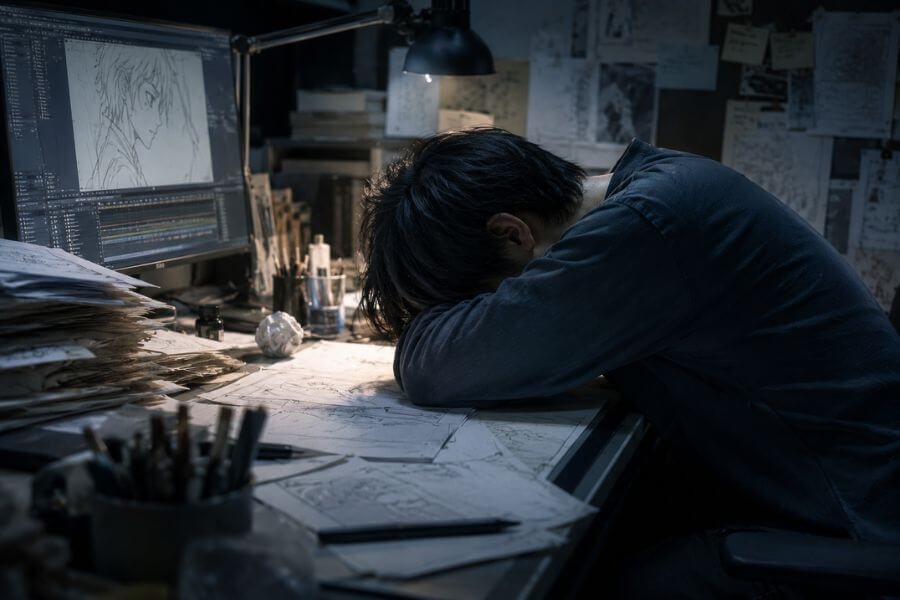
But if you look past the bright lights and the gorgeous art, a completely different story comes into view. The people who draw these worlds are exhausted. They are working long hours without proper sleep, skipped meals are a daily habit, and their health is failing. The very industry that builds dreams for millions of viewers is running on the fumes of exhausted artists. You might wonder how a business with so much money and success can let its most valuable creators suffer. The truth is that the current setup relies on a dark secret: using up the passion of young artists until they have nothing left to give.
This is not just a minor rough patch or a brief busy season. It is a deep structural mess that threatens the future of the art form itself. When you see an amazing action scene, you are looking at thousands of individual hand-drawn frames. Each frame represents minutes or hours of intense physical labor. When the pressure becomes too high, the human cost starts to show. To understand why this is happening, you have to look at how the business changed over the years and why the current explosion in global demand has pushed a fragile system completely over the edge.
A Massive Avalanche of Global Demand
For decades, international viewers had to search hard to find these shows. It was a niche interest supported by dedicated communities who traded tapes and built local clubs. Production companies made content almost entirely for their home country audience. The timelines were tight but predictable. Broadcast television slots were limited, which naturally capped the number of projects that could exist at any given time.
Then came the internet and the rise of massive online streaming networks. Suddenly, a show could premiere in Tokyo and stream across the Americas, Europe, and Asia at the exact same moment. Millions of new fans joined the community overnight. The financial potential became massive, and major entertainment corporations rushed to get a piece of the action. They poured money into production budgets, demanding more content, faster releases, and higher visual quality than ever before.
This change felt like a victory for fans, but for the creators, it became an absolute nightmare. The number of shows greenlit for production multiplied rapidly. Studios took on multiple massive projects at the exact same time to satisfy the endless hunger of streaming platforms. However, the number of skilled artists did not grow to match that demand. Instead, the same small pool of workers suddenly found themselves buried under an avalanche of work. You see the result of this every season: dozens of new titles dropping every single month, each trying to look more spectacular than the last, while the human machinery behind them cracks under the weight.
The Shift from TV Standards to Movie Quality
In the past, television shows used simple visual tricks to save time and energy. Characters would stay still while only their mouths moved, backgrounds were recycled, and complex action was kept to a minimum. Viewers understood and accepted these limits because it was standard for weekly broadcasts.
Today, your expectations as a viewer are much higher. You expect every single episode of a weekly show to look like a high-budget theatrical movie. The backgrounds must be detailed paintings, the lighting must be cinematic, and the action scenes must feature complex camera movements.
- Detailed character designs with intricate clothing and hair pieces
- Complex special effects that require manual frame-by-frame drawing
- Advanced digital compositing that blends traditional art with computer graphics
- Constant adjustments to match the hyper-detailed styles popularized by top directors
When studios try to deliver movie-level visuals on a television schedule, something has to break. Since the delivery dates are set in stone by contract, the only flexible factor is the health and time of the animators. They are forced to work at a frantic pace to ensure that the final product meets the sky-high standards of modern audiences.
The Low Pay Trap and the Piece-Rate Struggle
You might assume that because these shows make millions of dollars worldwide, the creators are living comfortable lives. The reality is shocking. A huge portion of the people who actually draw the frames you see are barely earning enough to survive. They often live in expensive major cities where the main studios are located, forcing them to squeeze into tiny shared apartments or rely on financial help from their parents just to buy groceries.
The root of this problem lies in a payment structure known as the piece-rate system. Instead of receiving a reliable monthly salary or an hourly wage that tracks their actual labor, many entry-level workers are paid a flat fee for every individual drawing they complete. This means if a drawing takes five hours to perfect because the design is incredibly complex, they still receive the exact same tiny payment as they would for a simple design that takes ten minutes.
This system creates a terrible trap. To earn enough money to pay for rent and food, an artist must work at a breakneck speed, sacrificing quality and their own physical well-being. It discourages careful craft and punishes workers who try to do a thorough job. If they slow down to make sure a scene looks perfect, they are effectively choosing to earn less money that day. It is a race against the clock that creates immense mental pressure and financial panic.
Breaking Down the Drawing Tiers
To understand how the money flows, it helps to look at the different types of artistic roles within a typical production pipeline. The tasks are strictly divided, and the pay scales differ wildly between the people who create the blueprint of a scene and the people who fill in the gaps.
Key animators are the experienced artists who draw the main poses of a scene. They establish the action, the timing, and the emotional expressions. Because their work requires high-level artistic skill and storytelling judgment, they are paid a higher rate per shot. They have more leverage in the industry, though they are still subject to intense deadline pressure.
In-between animators are usually the young beginners who entry the industry full of hope. Their job is to take the key drawings and fill in all the frames that happen in between them to create smooth motion. This work is highly repetitive and requires exact precision to keep the characters looking consistent. They are almost always paid by the individual sheet of paper, and their rates are notoriously low, often amounting to just a few dollars per drawing.
A Typical Monthly Budget Estimate for a Beginning Artist
To make this concrete, let us look at how the numbers shake out for a typical entry-level worker living in a major production hub city.
- Total drawings completed in a month: three hundred sheets
- Average payment per drawing sheet: four dollars
- Total gross monthly income: twelve hundred dollars
- Average rent for a tiny studio apartment: seven hundred dollars
- Cost of food and basic utilities: four hundred dollars
- Money left over for health, savings, or emergencies: one hundred dollars
When you look at these numbers, you can see why so many young people leave the business within their first three years. There is simply no safety net. If an artist gets sick, hurts their hand, or needs to take a few days off due to mental exhaustion, their income drops to zero instantly.
The Production Committee System Explained
You might wonder who is making all the money if it is not going to the artists. To find the answer, you have to look at how these projects are financed. The vast majority of animated shows are not owned or funded by a single animation studio. Instead, they are controlled by a powerful group called a production committee.
A production committee is a joint venture made up of several different corporations. This group usually includes a toy and merchandise manufacturer, a comic book publisher, a music record label, a video game company, and a major streaming or broadcasting network. Each company puts up a portion of the money needed to fund the show, which spreads out the financial risk. If a show fails completely, no single company loses everything.
However, this system also spreads out the rewards in a way that completely leaves out the animation studio. The committee members own the rights to the intellectual property. This means they pocket the profits from toy sales, video game adaptations, music soundtracks, and international streaming contracts. The actual animation studio is simply hired as a contractor. They receive a flat, pre-determined budget to produce the episodes, and they rarely see a single cent of the massive profits generated by a global hit.
The Squeeze on Studio Budgets
Because the production committee wants to maximize its own return on investment, they tend to keep the production budgets given to studios as low as possible. Studios compete against each other to win contracts, which often leads to a race to the bottom. A studio might accept an unrealistically low budget just to keep its doors open and its staff busy, hoping they can make ends meet through sheer speed.
Once a studio signs that contract, they are locked into a financial box. If the project runs into unexpected delays, if a director demands expensive rewrites, or if a scene requires extra staff to finish on time, the studio must absorb those extra costs. Since their budget is fixed, the easiest way for a studio to survive is to cut labor costs, keeping animator pay low and demanding more unpaid overtime from their workforce.
The Human Toll: Physical and Mental Health Costs
The structural problems of the business are not just abstract financial figures. They have a direct, painful impact on the minds and bodies of real people. When you watch a beautiful sequence, you are often looking at the product of intense human suffering. The lifestyle required to meet modern production deadlines is fundamentally unsustainable.
Animators spend ten, twelve, or even fourteen hours a day hunched over a drawing table or a digital tablet. They sit in the same position for hours on end, gripping a pen with tight focus. Over months and years, this constant physical strain takes a massive toll on their bodies. Chronic health conditions are not the exception in this industry; they are the baseline expectation for anyone who stays in the field for more than a few years.
- Severe repetitive strain injuries in the wrists, hands, and fingers
- Chronic lower back pain and spinal misalignment from poor seating options
- Intense eye strain and deteriorating vision from staring at bright screens in dark rooms
- Nutritional deficiencies caused by relying on cheap convenience store meals to save time
- Deep physical exhaustion from chronic sleep deprivation
The mental toll is just as severe as the physical damage. The constant pressure of looming deadlines creates a permanent state of anxiety. Artists live in fear of falling behind on their weekly quotas, knowing that their delays could ruin the schedule for the entire studio. This high-stress environment leads to widespread depression, panic disorders, and a total loss of self-worth among workers who once viewed their talent as a joyful gift.
The Normalization of Extreme Overtime
In many studios, staying overnight at the office is not viewed as an emergency measure. It is treated as a completely normal part of the job. It is common to see rows of desks equipped with sleeping bags, blankets, and travel pillows underneath them. Artists will work until they literally fall asleep at their desks, rest for a few hours, and then wake up to start drawing again immediately.
This culture of extreme sacrifice is often praised as dedication or passion. Senior staff members might boast about how many days they went without going home when they were young, passing down the expectation that survival of hardship is a necessary rite of passage. This mindset creates an environment where asking for a reasonable work-week or a healthy work-life balance is viewed as a sign of weakness or a lack of true artistic commitment.
Why Do They Stay? The Power of Passion Exploitation
It is a logical question to ask: if the conditions are truly this terrible, why do people continue to enter the industry? Why don’t they just pack up and find a job in a different field that pays better and respects their time? The answer lies in the deep, powerful love these artists have for the medium of animation.
Most animators grew up watching these same shows. The stories inspired them, comforted them during difficult times, and shaped their worldviews. From a very young age, their ultimate dream was to become a part of this creative legacy. They spent thousands of hours practicing their drawing skills, pouring their hearts into portfolio pieces, just to get a foot in the door.
Studio executives and production committees are well aware of this endless supply of passionate labor. They know that for every young artist who burns out and quits, there are ten more eager applicants waiting outside the door, ready to take their place. This dynamic allows the industry to treat its workforce as an expendable resource. Passion becomes a tool for exploitation; workers accept low pay and terrible treatment because they are told they are lucky to be working on their dream projects at all.
The Guilt of Leaving the Team
Another powerful force that keeps animators at their desks is a deep sense of loyalty to their peers. Animation is a highly collaborative team sport. If one person falls behind or walks away, their workload does not disappear; it gets piled onto the shoulders of their already exhausted coworkers.
This reality creates a powerful system of emotional guilt. An artist might want to quit for the sake of their own health, but they look around the room and see their friends struggling just as hard. They know that if they leave, they are making life even more miserable for the people they care about. So, they stay, sacrificing their own well-being to avoid letting their team down, while the overall system continues to profit from their collective guilt.
A Looming Crisis of Talent and Skill Preservation
The current burnout trend is not just a human tragedy; it is a long-term business disaster. By treating young animators as disposable parts, the industry is accidentally destroying its own foundation. The craft of high-quality hand-drawn animation takes years of patient practice and mentorship to master. When experienced artists leave the field in droves, that vital knowledge disappears with them.
In the past, there was a clear path of growth. A young artist would spend a few years doing in-between work, learning the rules of weight, momentum, and volume from senior key animators. They would receive regular feedback, gradually sharpening their skills until they were ready to take on more complex key animation tasks. This master-apprentice dynamic kept the artistic quality high across generations.
Today, that pipeline is completely broken. Because the turnover rate is so incredibly high, many studios have a massive gap in the middle of their workforce. They have plenty of brand-new, inexperienced beginners at the bottom, and a small handful of aging veterans at the very top, but almost nobody in between. There are not enough mid-level mentors left to train the newcomers, leading to a steady drop in baseline technical skills that studios are finding harder to hide.
The Reliance on Remote Freelancers
To fill the labor gaps caused by local burnout, studios are increasingly turning to a global network of online freelancers. They use social media platforms to find young digital artists living in various countries around the world, sending them shots to animate via email or cloud storage.
While this global outsourcing allows studios to finish their episodes on time, it introduces massive new complications to the production process.
- Language barriers that make detailed directorial notes difficult to communicate
- Time zone differences that delay urgent fixes and revisions during crunch hours
- Inconsistent training styles that make it hard to maintain a uniform visual look
- A total lack of job security or legal protections for international workers
This digital gig economy approach acts as a temporary band-aid on a deep, open wound. It allows studios to avoid fixing the core issues at home by pulling in fresh, passionate labor from elsewhere, continuing the cycle of exploitation on a global scale.
The Technological Mirage: Will AI or 3D Save the Day?
When outsiders hear about the labor crisis in animation, their immediate response is often to look toward technology for a quick fix. You will often hear tech enthusiasts claim that artificial intelligence, automated software, or three-dimensional computer graphics will solve the burnout crisis by doing the hard work automatically.
However, if you talk to actual working artists, they will tell you that this view is a total illusion. Technology does change the workflow, but historically, it has never actually reduced the total amount of labor required. Instead, whenever a new tool makes a specific task faster, production committees simply increase the visual complexity of the project and shorten the deadline, leaving the human worker just as stressed as before.
The Realities of Three-Dimensional Animation
Many modern productions use three-dimensional digital models instead of traditional two-dimensional drawings. While this eliminates the need to draw every single frame by hand, it does not magically eliminate hard labor.
Creating high-quality digital animation requires a massive team of technical artists. They have to build detailed models, create complex digital skeletons for movement, paint realistic textures, and manage digital lighting systems. The rendering process requires expensive computer hardware and constant troubleshooting. When a director wants to change a scene late in production, resetting a digital environment can be just as time-consuming and exhausting as redrawing a sequence on paper. The pressure points simply shift from the hands of traditional artists to the eyes of computer technicians.
The False Promise of Artificial Intelligence
In recent years, there has been a lot of talk about using generative artificial intelligence to automatically create background art or fill in the intermediate frames between key drawings. Promoters claim this will free artists from boring, repetitive tasks and let them focus entirely on high-level creativity.
In practice, current automated tools often create more work than they save. The frames generated by software often look strange, with floating details, unstable lines, and a complete lack of understanding of physical weight and character acting. Human animators must then spend hours fixing and cleaning up the messy digital output frame by frame. More importantly, using these tools threatens to eliminate the entry-level jobs where young artists traditionally learn their craft, making the long-term talent shortage even worse.
Comparing the Paths Forward for the Industry
The animation world stands at a critical fork in the road. The current path leads toward a complete collapse of visual quality and a total loss of skilled workers. To fix this, various groups are proposing different strategies to rebalance the relationship between business profit and human welfare.
| Strategy | Primary Benefit | Major Challenge |
| Moving to Full-Time Salaries | Provides reliable income and health benefits for artists | Requires studios to reduce the number of active projects |
| Reforming the Committee Structure | Directs merchandise and streaming profits back to the creators | Faces massive resistance from powerful media corporations |
| Unionization and Collective Action | Empowers workers to set mandatory limits on overtime and low pay | Difficult to organize due to a massive freelance workforce |
| Slower Production Schedules | Allows artists to focus on craft and maintain personal health | Conflicts with the constant demand for instant content |
Each of these solutions requires a fundamental shift in how the business values human labor. There is no magical solution that can fix the system without someone at the top agreeing to share more of the wealth or slow down the pace of production.
Signs of Hope: The Rise of Independent and Worker-Owned Studios
Despite the grim reality of the mainstream business, you can find exciting signs of resistance and positive change if you know where to look. A growing number of frustrated creators are taking matters into their own hands, breaking away from the traditional studio system to build alternative workplaces that prioritize human dignity.
Some of these new initiatives are structured as worker-owned cooperatives. In these unique studios, every employee has an equal vote in how the business is run, what projects they accept, and how the budget is split. There are no corporate executives pocketing millions while the artists starve. Decisions are made collectively, with a primary focus on ensuring that everyone earns a living wage and gets home in time for dinner.
Other studios are finding success by adopting a boutique model. Instead of trying to produce four or five television shows a year, they focus on creating just one high-quality project every two or three years. They negotiate directly with streaming platforms for larger upfront budgets and longer timelines, proving that it is possible to create world-class art without destroying the health of the creative team.
The Power of Fan-Funded Projects
The internet has also opened up new funding paths that completely bypass the traditional corporate production committees. Through crowdfunding platforms and direct subscription models, fans can fund independent animation projects directly.
This direct relationship between audience and creator changes the entire financial math of production. An independent team does not need to sell millions of toys or video games to break even. If they have a dedicated community of a few thousand fans who are willing to pay a small monthly fee to support their work, they can afford to pay themselves fair wages and take the time needed to make something truly special. This model is still small compared to the mainstream market, but it offers a beautiful blueprint for a more human future.
Your Role as a Viewer: Moving Beyond Passive Consumption
When you learn about the dark side of an industry you love, it can feel incredibly overwhelming. You might feel a sense of guilt the next time you sit down to watch a beautifully animated show, knowing the human cost that went into creating those images. You might wonder if the only moral choice is to boycott the medium entirely.
However, quitting the fandom is not what the artists want you to do. They love their work and want people to see it. What they need is an active, informed audience that values their labor and supports their fight for better conditions. As a fan, you hold more power than you think. Corporate executives pay close attention to audience sentiment, and when the community stands up for workers, it forces the people in charge to listen.
- Speak out on social media about production delays with empathy, supporting studios when they choose to push back a release date for health reasons.
- Educate your fellow fans about the realities of animator pay and working conditions, moving the conversation beyond simple praise for visuals.
- Support independent projects, worker-owned studios, and individual creator crowdfunding campaigns with your dollars.
- Demand transparency from major streaming platforms regarding how much of their licensing fees actually reach the production staff.
By changing how you consume and talk about animation, you can help shift the cultural narrative. When the global community values the well-being of the artist as much as the beauty of the final drawing, the industry will have no choice but to change its ways.
Frequently Asked Questions
Why don’t animators just form a massive union to demand better working conditions?
Forming a strong union is incredibly difficult in the modern animation landscape due to how the workforce is structured. A huge percentage of animators work as independent freelancers rather than permanent staff employees. They move from studio to studio on short-term contracts, often working from home. This fragmentation makes it very hard to organize collective actions like strikes. Furthermore, because there is an endless supply of young, passionate applicants eager to enter the industry, workers fear that if they try to organize or complain, they will simply be blacklisted and replaced immediately by someone else who is willing to work for less.
Do western animation studios face the exact same burnout crisis as eastern studios?
While western studios certainly deal with intense crunch periods, tight deadlines, and corporate stress, their structural setup is quite different. In many western countries, production workers are backed by established unions that enforce strict rules regarding minimum wages, mandatory overtime pay, health insurance, and maximum working hours per week. Western productions also rely much more heavily on the three-dimensional digital pipeline and longer pre-production planning phases. The specific crisis of artists earning less than a living wage while working fourteen-hour days on a piece-rate system is a unique product of historical financing models in specific regions.
Can the rise of digital drawing tablets fix the low pay issue by making drawing faster?
Digital drawing tablets and advanced software have certainly made the production pipeline cleaner by eliminating the need for physical paper, ink, and courier deliveries. However, technology has not solved the low pay problem. Under the piece-rate system, if an artist uses digital tools to complete a drawing twice as fast, the studio or production committee often responds by lowering the price paid per drawing or increasing the detail requirements for the characters. The financial benefit of increased efficiency almost always flows upward to the investors rather than downward to the creators who are doing the actual work.
How can I know if a specific show was made under healthy working conditions?
As an outside viewer, it can be very difficult to know exactly what happened behind the scenes of a specific production. However, there are a few clear warning signs you can look out for. If a show features sudden, dramatic drops in animation quality between episodes, if it requires multiple recap episodes in the middle of a season, or if the list of animation directors in the credits grows to an absurdly large number for a single episode, these are strong indicators that the production schedule completely collapsed and the staff was under extreme duress. Conversely, studios that take long breaks between seasons and maintain consistent quality tend to have better planning models.
Will buying official merchandise and Blu-ray discs help raise the wages of the animators?
Under the dominant production committee system, buying official merchandise, plastic figures, soundtracks, and home video releases rarely helps the animators directly. The profits from these retail items are pocketed almost entirely by the corporate members of the committee, such as the toy companies and publishers who funded the project. The animation studio itself received a flat fee to make the show months or years prior. If you want your money to support the creators directly, the best path is to look for independent crowdfunding campaigns, buy art books sold directly by the animators at conventions, or support studios that operate outside the traditional committee structure.