Table of Contents
Finding the right learning toys for your child can feel overwhelming. You want toys that are fun, safe, and useful for more than a few months. The good news is that some toys truly grow with your child and stay exciting from toddler years through preschool age.
Between ages 1 and 5, your child changes quickly. One year, they are stacking blocks, and the next, they are building pretend cities or solving puzzles on their own. The best learning toys adapt to those stages while helping your child build skills like creativity, problem-solving, language, motor skills, and confidence.
In this guide, you will discover learning toys that keep children engaged for years instead of ending up forgotten in a toy bin after a few weeks.
Quick Summary Table 🧸
| Toy | Best For | Age Range | Main Skills Developed |
|---|---|---|---|
| Building Blocks Set | Creative play | 1–5 | Motor skills, imagination |
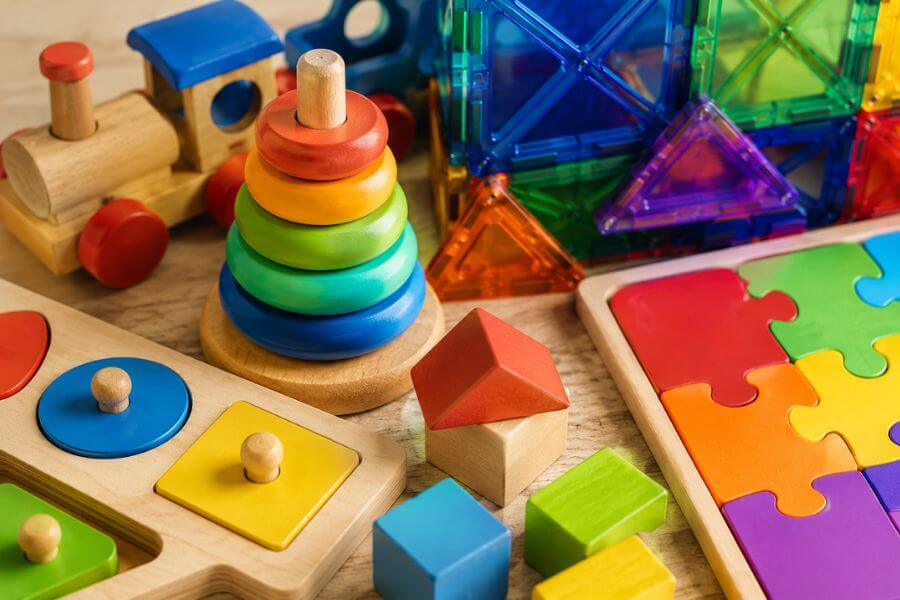
| Magnetic Tiles | STEM learning | 2–5 | Problem solving, spatial skills |
| Wooden Train Set | Pretend play | 2–5 | Coordination, storytelling |
| Shape Sorter and Stacking Toy | Early learning | 1–3 | Shapes, colors, coordination |
| Pretend Kitchen Set | Social skills | 2–5 | Communication, creativity |
| Musical Instruments Set | Sensory learning | 1–5 | Rhythm, listening skills |
| Puzzle Collection | Brain development | 2–5 | Focus, logic, patience |
| Art Easel and Craft Kit | Creativity | 2–5 | Fine motor skills, expression |
| Balance Bike | Physical development | 2–5 | Balance, coordination |
| Interactive Storybook Set | Language growth | 1–5 | Vocabulary, listening |
How We Ranked These Learning Toys 🏆
We focused on toys that continue to stay useful as your child grows from age 1 to 5. Here are the key factors we considered:
- Long-lasting play value
- Ability to match different age levels
- Educational benefits without feeling like school
- Safety and durability
- Encouragement of independent play
- Creativity and imagination support
- Development of motor and social skills
- Easy setup and simple cleanup
- Variety of ways to use the toy
- Parent-friendly quality and reliability
1. Building Blocks Set 🧱
Building blocks are one of the few toys that almost never go out of style for young children. At age 1, your child may simply stack and knock them down. By age 5, they may build houses, bridges, towers, and entire pretend cities.
Blocks help develop hand and eye coordination, patience, and creativity. They also encourage problem-solving because your child learns what works and what falls apart.
Wooden blocks are especially great because they are sturdy and simple. Without flashing lights or sounds, your child becomes the creator of the fun instead of relying on the toy to entertain them.
You can also use blocks for learning activities like:
- Counting
- Sorting colors
- Learning shapes
- Creating patterns
- Practicing teamwork
This toy grows naturally with your child and stays useful for years.
2. Magnetic Tiles 🔷
Magnetic tiles are popular for a reason. They are colorful, easy to handle, and exciting for children at many stages of development.
Younger toddlers enjoy connecting simple shapes together. Older preschoolers can build castles, ramps, garages, and more advanced structures.
These toys introduce early STEM learning in a playful way. Your child learns about balance, design, geometry, and basic engineering while having fun.
Another great feature is that magnetic tiles work well for solo play and family play. You can build together and encourage your child to explain their ideas and creations.
Parents also love that these sets are easy to store and stay interesting for a long time.
3. Wooden Train Set 🚂
A wooden train set offers years of open-ended play. At first, your child may push trains across the floor and connect simple tracks. As they grow older, they can build more complex layouts and create stories around the trains.
This type of toy supports imagination in a big way. Your child may pretend to deliver food, transport animals, or run a busy city station.
Train sets also help with:
- Fine motor development
- Planning skills
- Creativity
- Social interaction
- Hand coordination
Many train sets can expand over time with extra pieces, bridges, and accessories. That keeps the toy feeling fresh without needing a completely new setup.
4. Shape Sorter and Stacking Toy 🟠
Shape sorters may look simple, but they offer important learning opportunities during the toddler years.
At age 1, your child starts exploring colors and shapes. Later, they begin solving problems by figuring out which pieces fit where.
Stacking toys also teach balance, sequencing, and coordination. As children grow, they often use these toys in creative ways beyond the original purpose.
For example, stacking cups may become pretend food containers, bath toys, or building pieces.
Look for sets with bright colors, safe materials, and different levels of difficulty to keep your child challenged as they grow.
5. Pretend Kitchen Set 🍳
Pretend play becomes very important between the ages of 2 and 5. A toy kitchen encourages communication, imagination, and social development.
Your child may pretend to cook meals, serve snacks, or run a restaurant. This kind of role-playing helps children understand daily routines and build confidence.
Kitchen play also supports language growth because children naturally practice new words and conversations during pretend activities.
Many children continue using pretend kitchens for years because the play evolves over time. One day, they are simply stirring a pot, and another day, they are creating full imaginary dinner parties.
Adding toy food, menus, and play dishes can make the experience even richer.
6. Musical Instruments Set 🎵
Young children love making noise, but musical toys can offer much more than entertainment.
Simple instruments like tambourines, drums, xylophones, and maracas help children:
- Develop rhythm
- Improve listening skills
- Explore sound patterns
- Build coordination
- Express emotions
At a younger age, your child experiments with sounds. As they grow, they begin following rhythms, singing songs, and creating simple performances.
Music also supports memory and language development. Singing along to songs can help children learn words and sentence patterns naturally.
Choose instruments that are durable and easy for small hands to hold comfortably.
7. Puzzle Collection 🧩
Puzzles grow with children extremely well because you can gradually increase difficulty over time.
A young toddler may start with large knob puzzles featuring animals or shapes. Preschoolers can move on to more detailed puzzles with letters, numbers, or scenes.
Puzzles teach patience and focus while strengthening problem-solving skills. They also help children understand spatial relationships and improve hand control.
Rotating different puzzles throughout the year keeps the challenge fresh and exciting.
You can also turn puzzles into social activities by solving them together and talking through the process.
8. Art Easel and Craft Kit 🎨
Creative toys that allow open-ended expression often stay useful for many years. An art easel combined with washable craft supplies gives your child endless opportunities to create.
At younger ages, children enjoy scribbling and experimenting with colors. As they grow, they begin drawing people, animals, shapes, and imaginative scenes.
Art activities help develop:
- Fine motor skills
- Creativity
- Emotional expression
- Hand strength
- Focus
A double-sided easel with chalkboard and whiteboard features can add even more variety.
Simple craft supplies like crayons, stickers, paper, and washable paint can turn ordinary afternoons into exciting learning moments.
9. Balance Bike 🚴
A balance bike is one of the best physical learning toys for young children. Instead of using training wheels, balance bikes teach your child how to balance naturally from the beginning.
Toddlers start by walking while sitting on the bike. Over time, they learn to glide smoothly and steer with confidence.
This toy supports:
- Physical coordination
- Confidence
- Independence
- Gross motor development
- Outdoor activity
Many children transition to regular bikes more easily after using a balance bike for a year or two.
Look for lightweight designs that are easy for young children to control safely.
10. Interactive Storybook Set 📚
Books that include sounds, textures, questions, or matching activities can keep children engaged through several stages of development.
For younger toddlers, interactive books encourage sensory exploration and listening skills. Older children benefit from storytelling, vocabulary growth, and early reading practice.
Reading together also strengthens emotional bonds and helps create calming routines.
Storybook sets that include puppets, flashcards, or matching games can extend learning beyond reading time.
Children who enjoy books early often continue developing strong language and communication skills as they grow.
Conclusion 🌟
The best learning toys are the ones that continue to challenge and inspire your child year after year. Instead of buying toys that only match one short stage, you can choose options that adapt as your child grows from age 1 to 5.
Toys like blocks, magnetic tiles, pretend kitchens, puzzles, and musical instruments encourage creativity and learning in ways that feel natural and fun. They also help you save money because they stay useful longer.
When choosing learning toys, focus less on flashy features and more on open-ended play. The toys that allow your child to imagine, build, explore, and create are often the ones they return to again and again.
Frequently Asked Questions ❓
How many learning toys should a child have?
Children do not need a huge number of toys. A smaller collection of high-quality toys often works better because it encourages deeper play and creativity instead of constant distraction.
Are electronic learning toys better than traditional toys?
Not always. Traditional toys often encourage more imagination, movement, and problem-solving. Electronic toys can be useful in moderation, but open-ended toys usually provide longer-lasting developmental benefits.
How can you keep learning toys interesting for longer?
Try rotating toys every few weeks instead of keeping everything available all the time. This makes older toys feel fresh and exciting again.
What safety features matter most for toddlers?
Look for non-toxic materials, rounded edges, strong construction, and age-appropriate sizes that do not create choking hazards.
Can one toy really work for ages 1 through 5?
Yes, many open-ended toys can adapt to different stages. For example, blocks may start as stacking toys for toddlers and later become building tools for imaginative preschool play.